Associated Country
 United States
 Periodic Safety Update Reports (PSURs) are critical documents for medical device and in vitro diagnostic product manufacturers. These reports are a key component of a manufacturer’s post-market surveillance and risk management program, providing ongoing assessment of the safety and performance of their products. In this blog, we will explore what PSURs are, what information they contain, and why they are important. We will also discuss the regulatory requirements for PSURs, the process for preparing and submitting them, and some best practices for ensuring their accuracy and completeness.
What is a PSUR in medical devices?
PSUR is an acronym for Periodic Safety Update Reports. In the medical device context a PSUR is a comprehensive report that provides an evaluation of the safety and performance of a medical device or in vitro diagnostic product over a defined period of time. The report summarizes the manufacturer’s post-market surveillance activities, including adverse event reporting, complaint handling, and other sources of safety information. The purpose of the report is to identify any potential safety concerns associated with the use of the product and to assess the risk-benefit balance.
What information is included in a PSUR?
PSURs typically include the following information:
- Executive Summary: This section provides a brief overview of the report’s content and findings.
- Introduction: This section provides background information on the product, including its intended use, regulatory status, and any significant changes since the previous PSUR.
- Post-Market Surveillance (PMS) Activities: This section describes the manufacturer’s post-market surveillance activities conducted in accordance with the PMS plan required under Article 84 of the EU MDR, including adverse event reporting, complaint handling, field safety corrective actions, literature surveillance, and other sources of safety and performance information.
- Safety Evaluation: This section summarizes the safety data collected during the reporting period, including any adverse events, trends, and emerging safety concerns.
- Benefit-Risk Assessment: This section evaluates the product’s risk-benefit balance based on the safety and effectiveness data collected during the reporting period.
- Conclusion and Recommendations: This section provides a summary of the report’s findings and any recommendations for further action.
Regulatory Requirements for PSURs:
The regulatory requirements for PSURs vary depending on the jurisdiction and the type of product.
PSUR Requirements EU MDR
In the European Union (EU), PSURs are required under Article 86 of EU MDR 2017/745 for Class IIa, IIb, and Class III medical devices, and under Article 81 of EU IVDR 2017/746 for Class C and D IVDs. The frequency of updates is defined by device classification:
Under EU MDR:
- Class IIb and Class III devices: PSUR must be updated at least annually
- Class IIa devices: PSUR must be updated at least every two years
- Class III and implantable devices: PSUR must be submitted via EUDAMED to the Notified Body for review and assessment
- Class IIa and non-implantable Class IIb devices: PSUR must be made available to the Notified Body and, upon request, to competent authorities
Under EU IVDR:
- Class C and D IVDs: PSUR must be updated at least annually
- Class D IVDs: PSUR must be submitted via EUDAMED to the Notified Body
PSURs are part of the technical documentation and must be maintained throughout the lifetime of the device plus any applicable shelf life period. The MDCG guidance document MDCG 2022-21 provides the recommended structure and content requirements for a compliant PSUR under the MDR.
2026 Update- EUDAMED Now Mandatory: As of May 28, 2026, use of EUDAMED’s four core modules is mandatory for all economic operators under EU MDR and IVDR. This directly affects PSUR submission and access obligations. Class III and implantable device manufacturers who are required to submit PSURs via EUDAMED must ensure they have completed Actor Registration and obtained a Single Registration Number (SRN) before this date. Devices placed on the market before May 28, 2026, must be registered in the UDI/Device module by November 27, 2026. Manufacturers who have not yet initiated EUDAMED registration should treat this as an urgent compliance priority without an SRN, no regulatory activity in EUDAMED can proceed, including PSUR submission.
Upcoming Change to Watch- MDR/IVDR Simplification Proposal: In December 2025, the European Commission proposed targeted amendments to the EU MDR and IVDR (COM/2025/1023) that include a reduction in PSUR update frequency for certain device classes. If adopted, the proposal would reduce the reporting burden for some manufacturers, potentially moving Class IIb devices to a biennial cycle and further easing requirements for Class IIa. This proposal is currently under legislative review by the European Parliament and Council and has not yet been adopted but current PSUR frequencies under Article 86 remain in force. Manufacturers should monitor this proposal closely as it progresses through the legislative process, with full adoption expected no earlier than 2027–2028.
PSUR Requirements in the US
In the United States, PSURs are not required by the Food and Drug Administration (FDA) for medical devices or in vitro diagnostics (IVDs). However, manufacturers are still required to conduct post-market surveillance activities and report adverse events to the FDA. Under the Consolidated Appropriations Act of 2023, medical device manufacturers must also comply with updated quality system requirements and the FDA’s new Quality Management System Regulation (QMSR), effective February 2, 2026, aligns US quality system requirements with ISO 13485, reinforcing the importance of robust post-market surveillance processes even without a formal PSUR mandate.
Determine if Your Medical Device or IVDR needs PSUR
If you’re unsure if your device or IVDR needs to go through the Periodic Safety Update Report process, you’re not alone. This diagram should help you understand the path to take.
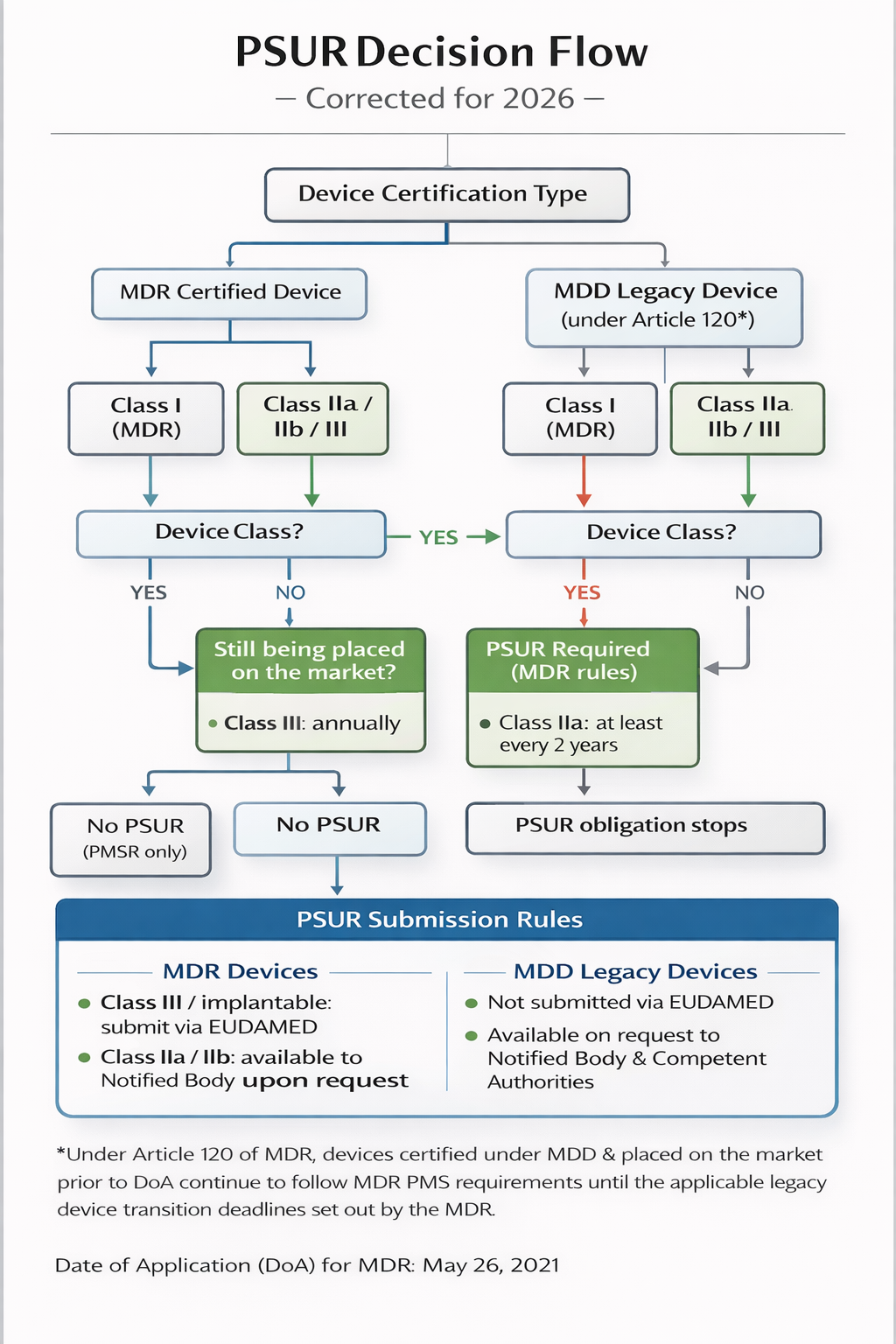
Process for Preparing and Submitting PSURs:
The process for preparing and submitting PSURs involves several steps, including:
- Data Collection: The manufacturer collects safety and performance data for the reporting period, including adverse events, complaint handling, and other sources of safety information.
- Data Analysis: The manufacturer analyses the data to identify any safety concerns or emerging trends.
- Report Writing: The manufacturer prepares the PSUR, including an executive summary, introduction, safety evaluation, benefit-risk assessment, and conclusions.
- Internal Review: The manufacturer conducts an internal review of the PSUR to ensure its accuracy and completeness.
- Submission: The manufacturer submits the PSUR to the regulatory authority or notified body, as required.
Managing this process manually across multiple markets and device classes is one of the most common compliance challenges manufacturers face, particularly as EUDAMED submission requirements take effect in 2026. RegDesk’s RIM platform is designed to support exactly this workflow. With regulatory intelligence covering 120+ markets, RegDesk helps manufacturers centralize PSUR documentation, track submission schedules by device class, and stay ahead of regulatory changes that affect post-market obligations globally. All customers receive implementation support and a dedicated success team to guide long-term compliance growth.
Workflow for assessment of PSUR requirement:
To ensure the accuracy and completeness of PSURs, manufacturers should follow some best practices, including:
- Establishing a robust post-market surveillance program that includes the collection and analysis of safety and performance data.
- Conducting regular internal reviews of safety data to identify emerging safety concerns.
- Ensuring that all adverse events and complaints are reported in a timely manner to the regulatory authority or notified body.
- Designing PSURs to be comprehensive and transparent, with clear and concise
- Involving cross-functional teams in the preparation of PSURs, including representatives from regulatory affairs, clinical development, and quality assurance.
- Providing a clear and detailed description of the product and its intended use, as well as any significant changes since the previous PSUR.
- Ensuring that the safety evaluation and benefit-risk assessment sections are based on robust data and analysis and that any limitations or uncertainties are clearly communicated.
- Providing a comprehensive summary of adverse events and other safety data, including a description of the severity, frequency, and outcome of each event.
- Including a thorough review of the product’s labeling and instructions for use, to ensure that they are accurate and up to date.
- Continuously monitoring the safety and performance of the product and updating the PSUR as needed.
Maintaining these best practices across a global portfolio, with different PSUR frequencies, Notified Body expectations, and now EUDAMED submission deadlines, requires a centralized system, not a spreadsheet. RegDesk’s platform helps regulatory teams prepare and publish submissions, manage standards, conduct impact assessments, and monitor regulatory changes in real time across 120+ markets. Expanding into new markets while staying on top of post-market obligations has never been more manageable. Curious about how RegDesk can support your PSUR program? Schedule a demo today.
The Difference Between a PSUR and PMSR
While both the Periodic Safety Update Report (PSUR) and the Post-Market Surveillance Report (PMSR) serve to monitor the ongoing safety and performance of medical devices, they apply to different device classes and have distinct reporting requirements under the EU MDR and IVDR.
A PSUR is required for higher-risk devices, specifically Class IIa, IIb, and III medical devices and Class C and D IVDs, and must be updated and submitted to the Notified Body (and mandatorily via EUDAMED for Class III and implantable devices from May 28, 2026) at defined intervals.
The PMSR applies to lower-risk devices (Class I medical devices and Class A/B IVDs) and is generally maintained internally by the manufacturer without formal submission. The PMSR summarizes post-market findings but does not require the same depth of analysis or periodic submission as a PSUR.
Associated Country
United States Periodic Safety Update Reports (PSURs) are critical documents for medical device and in vitro diagnostic product manufacturers. These reports are a key component of a manufacturer’s post-market surveillance and risk management program, providing ongoing assessment of the safety and performance of their products. In this blog, we will explore what PSURs are, what information they contain, and why they are important. We will also discuss the regulatory requirements for PSURs, the process for preparing and submitting them, and some best practices for ensuring their accuracy and completeness.