Short answer: UDI and EUDAMED compliance software helps medical device companies maintain identifier, device, registration, and market data in a structured system. For companies operating across multiple products or markets, a device-focused RIM platform can connect that data to registrations, change assessments, renewal dates, and supporting records in one controlled workflow.
The real test of UDI software is not whether it has a UDI field. It is whether the system can represent the different data structures, workflows, and regulatory requirements behind GUDID and EUDAMED, then connect those records to the products, markets, and changes they affect.
This is where a device-focused RIM platform can extend UDI data management beyond individual databases. RegDesk is a device-native RIM platform that connects medical device registration data, renewal tracking, change assessment, regulatory intelligence, and submission workflows, giving regulatory teams a connected view of products, markets, registrations, and regulatory requirements.
As with any platform, you will still want to confirm the exact UDI fields, exchange formats, validation evidence, and implementation scope your own portfolio demands.
What is a UDI?
A Unique Device Identifier identifies a medical device through distribution and use. The US and EU both run UDI frameworks. The identifiers, data fields, databases, applicability rules and submission processes are not the same. UDI is therefore both an identification framework and a structured regulatory data requirement, with different implementation rules depending on the jurisdiction.
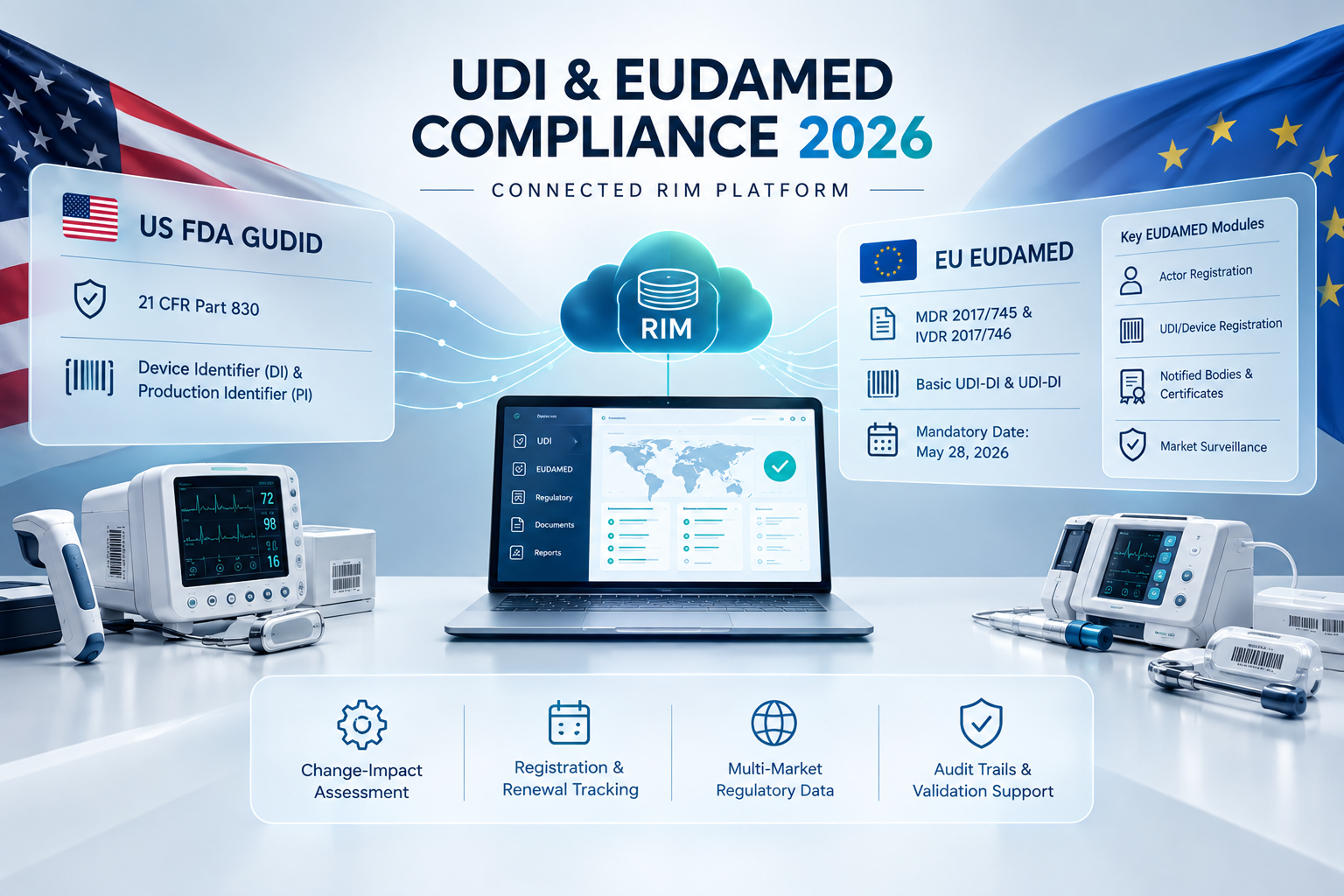
Under 21 CFR Part 830, a US UDI includes a device identifier and, where applicable, production identifier information, and covered labelers submit specified device-identification data to the FDA’s Global Unique Device Identification Database, GUDID, subject to the framework’s exceptions.
Under the EU MDR and IVDR, the framework runs instead on the Basic UDI-DI and UDI-DI concepts, and the required data for in-scope devices is managed through the UDI/Device Registration module of EUDAMED, the European database on medical devices.
Sell in both regions and you carry two related but separate obligations. Reusing a common product record improves your consistency. A common product record can support consistency across markets, but GUDID and EUDAMED remain separate regulatory systems with different data requirements and workflows.
What changed for EUDAMED in 2026?
Following Commission Decision (EU) 2025/2371, use of four EUDAMED modules became mandatory from May 28, 2026:
- Actor Registration
- UDI/Device Registration
- Notified Bodies and Certificates
- Market Surveillance
For a detailed explanation of the EUDAMED rollout and module requirements, see RegDesk’s Understanding EUDAMED guide.
Confirm the current scope, transition provisions and module status on the European Commission’s EUDAMED overview, particularly for legacy devices and the other cases that carry rules of their own.
In practice the requirement is this: keep accurate actor, device, certificate and UDI data for the records that apply to you, while you go on meeting separate obligations in the United States and every other market you sell into.
Why does multi-market UDI data get so hard to manage?
UDI management becomes difficult when a change crosses product, packaging, registration, and market boundaries. A label revision, new model, manufacturing change, or change in intended use can affect identifiers and registrations differently across jurisdictions. Nobody schedules a UDI data cleanup. It arrives as a packaging change someone approved on a Thursday, and by the following week a regulatory associate is opening four spreadsheets to work out which models the change touched, which registrations reference those models, whether the identifiers move, and who in which region has to do something about it, because a label revision, a new model, a manufacturing update or a changed intended use each land differently on your identifiers and registrations depending on the product, the change and the rules in each jurisdiction.
Duplicated spreadsheets make that tracing worse. You reconcile several copies of the same product data, decide which record is authoritative, and chase registration and renewal dates by hand.
A shared regulatory data model takes most of that reconciliation out. It ties the product record to its market registrations, identifiers, supporting documents, change assessments, owners and deadlines, without pretending one jurisdiction’s data can be poured straight into another.
GUDID and EUDAMED, side by side
| Dimension | FDA GUDID (US) | EUDAMED (EU) |
|---|---|---|
| Governing rule | 21 CFR Part 830 | MDR 2017/745 and IVDR 2017/746 |
| Core identifier | Device identifier, plus production identifier information where applicable | Basic UDI-DI and UDI-DI |
| Database Operator | FDA | European Commission |
| Primary Purpose | Device identification data | Actor, device, certificate, and market-surveillance data |
| Scope | Device identification | Broader regulatory database covering multiple modules |
The UDI concept is shared, but the identifiers, data structures, regulatory requirements, and workflows are different.
What should you look for in UDI and EUDAMED compliance software?
Structured device, UDI, and registration records
Can it represent your product hierarchy and identifiers, device identifiers, Basic UDI-DI relationships, packaging levels, models, market registrations? Ask to see those exact fields and relationships against a realistic sample from your own portfolio, not a demo record built to look tidy.
Separate handling for GUDID and EUDAMED
Confirm how the system treats the different attributes and workflows the FDA and EU require. A shared source record can improve consistency, but jurisdiction-specific data must remain distinct. What you want to see is market-specific data preserved, and a straight answer on which information is submitted, which is exported, and which someone still keys in by hand.
Change-impact assessment
A UDI change rarely exists in isolation. A change to a model, packaging, component, labeling, or intended use can ripple into identifiers, registrations, and market-specific obligations. Be wary of any tool that claims changes resolve themselves automatically; good software supports regulatory judgment, it doesn’t replace it.
Registration and renewal tracking
Look for ownership, status, milestone, expiration and renewal fields with configurable notifications. UDI data is only useful when teams can connect it to the registrations and market obligations that depend on it.
Audit trails, access controls, and validation support
Establish how the platform records changes, preserves prior values, controls access, and supports review and approval. Where you use electronic signatures on regulated records, ask the vendor to evidence how they operate. For Part 11-relevant use, put validation responsibilities and the available qualification documentation on the same list.
Regulatory intelligence with accountable review
UDI requirements can change alongside broader regulatory requirements. The software should connect a regulatory change to the affected market, product, requirement, and resulting action rather than treating intelligence as a separate news feed.
Integrations and data ownership
Your UDI and registration data usually depends on product, label, quality and document records living somewhere else. Check the APIs and connectors for PLM, eQMS, ERP, eDMS, identity and analytics. Before integrating systems, decide which system owns each regulatory data element. Otherwise, an integration can automate the movement of inconsistent data rather than solve the underlying problem.
Migration and operating model
Implementation effort scales with your products, markets, identifiers, historical records, integrations and validation requirements. Ask to see how legacy data gets cleaned, mapped, approved and maintained after go-live. Technology alone does not establish data governance. Define ownership, review responsibilities, approval workflows, and maintenance expectations before migration.
How RegDesk connects UDI and registration data
RegDesk connects device, market, registration, change, and regulatory intelligence data in a device-focused RIM environment through:
- Device and market registration tracking
- UDI and registration data relationships
- Change assessment by product and market
- Registration and renewal tracking
- Regulatory intelligence connected to affected products and markets
- Submission preparation and supporting workflows
RegDesk maintains a current SOC 2 Type II report and is ISO/IEC 27001 certified. The platform complies with GDPR and provides controls designed to support FDA 21 CFR Part 11 and GxP use cases, including audit trails and electronic signatures. See trust and compliance. Security and validation documentation covering your intended use is available upon request.
Explore customer success stories, on our case studies page.
What results can you put in a business case?
According to a Forrester Total Economic Impact study commissioned by us, a composite of interviewed customers saw 196% ROI over three years, $2.6M net present value, and payback in under six months. See the study. Separately, RegDesk customer evidence includes 35+ hours saved per application and examples of scaling into new markets without proportionally adding headcount.
Use the study’s composite results as one input to your business case, then model expected value from your own submission volumes, labor costs, implementation scope, and adoption assumptions.
When you may not need this yet
There are real situations where a UDI and EUDAMED platform is more than you need right now:
- You sell in one market with a small, stable catalog. One GUDID submission set and a well-kept spreadsheet can carry you for a while.
- You’re not yet in scope for EUDAMED. If your EU obligations currently sit with an arrangement you haven’t had to touch, your current EU obligations may not yet require the EUDAMED work described here .
- Your identifiers barely move. If you haven’t changed a package configuration or a model number in two years, the change-assessment machinery has nothing to chew on.
- You’re pre-first-submission. Until you have registrations to keep current, most of the value is latent.
The real challenge begins when the same product data must remain accurate across multiple regulatory systems, markets, and workflows. At that point, UDI management becomes part of a broader regulatory data-management problem: keeping products, identifiers, registrations, changes, and deadlines connected as the portfolio evolves.
Frequently asked questions
Is FDA GUDID the same as EU EUDAMED?
No. GUDID is the FDA’s US database for device-identification data; EUDAMED is the EU database supporting several medical-device regulatory processes. They share the UDI concept and not much else — different identifiers, attributes, legal requirements and submission workflows.
When did the first four EUDAMED modules become mandatory?
Actor Registration, UDI/Device Registration, Notified Bodies and Certificates, and Market Surveillance became mandatory from May 28, 2026. Confirm current scope and transition details on the European Commission’s EUDAMED site.
What does UDI compliance software actually do?
It keeps your identifier and registration data structured, connects changes to the records they affect, manages review and ownership, tracks deadlines, and retains the evidence. What’s included varies by platform and by how you configure it.
Can one platform manage both US and EU registration data?
Yes, a properly configured platform holds both in one controlled environment. You’ll still want to confirm field coverage, submission or export support, data ownership, validation, and how jurisdiction-specific requirements get treated.
What is the difference between UDI software and RIM software?
UDI software focuses specifically on managing unique device identification data and related regulatory requirements. RIM software provides a broader regulatory data and workflow environment that can connect UDI information with products, market registrations, submissions, regulatory changes, renewals, and supporting records.

