Overview
To market a medical device in Ireland, manufacturers must first obtain CE marking demonstrating conformity with EU MDR or IVDR. Ireland’s national competent authority for medical devices is the Health Products Regulatory Authority (HPRA), which operates under EU-harmonized regulations while maintaining specific national registration obligations under S.I. 691/2021 (Medical Devices Registration Regulations 2021).
A major shift is underway in 2026: mandatory use of four EUDAMED modules begins on May 28, 2026, following the European Commission’s publication of confirmed functionality in November 2025. This means that EUDAMED registration, previously treated as voluntary or transitional, is now a firm legal requirement for most economic operators placing devices on the Irish and EU markets.
Device Classification
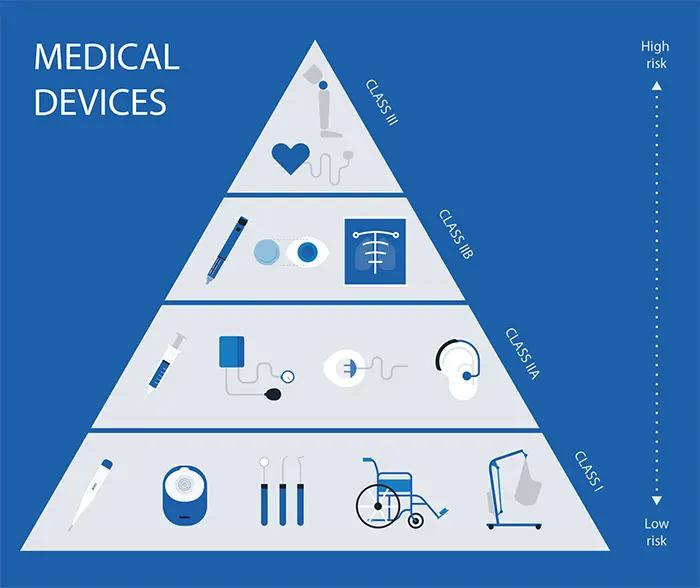
Devices are classified according to EU MDR/IVDR rules into Class I, Class IIa, Class IIb, and Class III for medical devices, and Class A, B, C, and D for IVDs. Higher classes correspond to higher risk and require more stringent regulatory scrutiny, including notified body involvement.
Manufacturers should note that MDR reclassification has moved many devices previously in lower risk classes into higher ones (particularly software, substance-based devices, and reusable surgical instruments) so confirming your device’s current classification under MDR/IVDR (not MDD/IVDD) is an essential first step before initiating any registration process.
Ireland Medical Device Registration Requirements
CE Marking
All devices must bear CE marking under EU MDR or IVDR before being placed on the Irish market. Manufacturers should ensure their CE marking is issued under the current regulations; CE marks issued under the legacy MDD or IVDD have expired transition deadlines and are no longer valid for new placements on the market. For devices transitioning from MDD to MDR, the extended transition deadlines (Class IIb/III devices by December 31, 2027; other classes by December 31, 2028) apply only to devices already certified; new CE marks must be obtained under MDR.
EUDAMED Registration
Mandatory use of four EUDAMED modules begins on May 28, 2026. This follows the European Commission’s formal confirmation of functionality in November 2025. The four mandatory modules are: Actor Registration, UDI/Device Registration, Notified Bodies and Certificates, and Market Surveillance.
The HPRA validates EUDAMED registration applications for economic operators established in Ireland and their non-EU manufacturers. Once validated, you will receive a Single Registration Number (SRN) from EUDAMED. Any registrations validated on EUDAMED are also registered nationally. Complete registration applications are processed within 10 working days.
Key deadlines for device registration in EUDAMED: new devices placed on the market from May 28, 2026 must be registered in the UDI/Device module before the first unit is placed on the market. Devices already on the market before May 28, 2026 but continuing to be sold must be registered by November 27, 2026.
There is an annual maintenance fee for all registered economic operators. Invoices are sent in quarter 2 of each year. HPRA fees increased by 2.5% for 2026 to reflect inflation.
HPRA National Registration
Registration obligations must be fulfilled before products are placed on the market or used. If you meet the definition of more than one type of economic operator, you must register for each role separately.
The following entities register via EUDAMED (validated by HPRA): manufacturers (including Class III custom-made device manufacturers), authorized representatives, importers, and system and procedure pack producers (SPPPs) established in Ireland.
The following entities register directly with HPRA (not via EUDAMED): distributors established in Ireland; health institutions manufacturing devices for in-house use; and manufacturers of custom-made Class I, IIa, and IIb devices (excluding Class III implantable custom-made devices). An initial administration fee of €145 must be paid when registering directly with HPRA.
Manufacturers based in other EU member states who have registered via EUDAMED do not need to separately register with HPRA to place their products on the Irish market.
Device Registration
Device registration is now processed exclusively through EUDAMED’s UDI/Device module for MDR/IVDR-compliant devices. The previous workaround of submitting device data to HPRA via MDR/IVDR spreadsheets applied only while EUDAMED was not fully functional: from May 28, 2026, EUDAMED is the mandatory channel.
Legacy devices (those certified under MDD/IVDD): the deadlines for marketing legacy devices under MDD have now passed (May 27, 2024 for placing on market; May 27, 2025 for making available). Any device being placed on the Irish market from 2025 onward must hold a valid MDR or IVDR CE certificate. Manufacturers still relying on legacy certification should treat obtaining MDR/IVDR compliance as an immediate priority.
Registration Numbers
Non-EU manufacturers must link their organization to an authorized representative via EUDAMED. This step can only be completed once the authorized representative has obtained a Single Registration Number (SRN) from EUDAMED. From May 28, 2026, having a valid SRN is a prerequisite, not a recommendation, for placing any new device on the EU/Irish market. Manufacturers and authorized representatives who have not yet completed Actor registration should do so immediately to avoid market access disruption.
Authorized Representative
Authorized representatives established in Ireland must register their organization details on EUDAMED. Authorized representatives should also ensure that the associated non-EU manufacturer has linked their organization to the relevant authorized representative on EUDAMED; this linking step is required before the non-EU manufacturer can complete device registration.
Ireland-based authorized representatives are a popular choice for non-EU manufacturers given Ireland’s English-language environment and established MedTech industry, but the same EU-wide AR obligations apply regardless of where in the EU the AR is located.
Quality Management System
A Quality Management System (QMS) certified to ISO 13485:2016 is effectively required under EU MDR/IVDR for most manufacturers, while technically “recommended” for some Class I devices, it is a prerequisite for notified body certification for Class IIa and above. ISO 13485 certificates are typically valid for three years, while EU device certificates under MDR/IVDR are valid for five years.
Manufacturers should also note that the FDA’s QMSR (Quality Management System Regulation), which took effect February 2, 2026, aligns U.S. quality system requirements with ISO 13485:2016: meaning manufacturers pursuing both EU and U.S. market access can significantly leverage a single QMS framework across both jurisdictions.
Timeframes
Complete HPRA registration applications (both national and EUDAMED) are processed within 10 working days once all required information is submitted. This applies to the HPRA validation step specifically.
Overall timelines from initial preparation to market readiness vary significantly by class: Class I devices can typically be ready for market within 4–8 weeks from the start of the registration process, assuming CE marking is in place. Class IIa–IIb devices requiring notified body certification typically take 3–9 months depending on notified body capacity. Class III devices and implantable devices can take 12–24 months or more, factoring in notified body capacity constraints and clinical evaluation review.
Manufacturers should factor EUDAMED data preparation time into their project timelines; experience from early adopters indicates data readiness and upload validation can take weeks even after registration is initiated.
Wholesale Distribution Authorizations (WDA)
Entities distributing healthcare products in Ireland must apply for a Wholesale Distribution Authorization (WDA) from HPRA. Requirements include: a permanent physical site in Ireland for wholesale activities; details of all sites and relevant authorizations; technical agreements and evidence of Good Distribution Practice (GDP) compliance; and completion of a HPRA audit. Note the typo in the original summary table (“WDA if disturbing”): this should read “if distributing.” Distributors established in Ireland who do not register via EUDAMED must register directly with HPRA. HPRA fees increased by 2.5% across all categories for 2026, including WDA-related fees; budget accordingly.
Recent Updates
The following are the most significant 2025–2026 HPRA and EU-level updates affecting Ireland registrations:
- EUDAMED mandatory from May 28, 2026: Four modules (Actor, UDI/Device, NB/Certificates, Market Surveillance) are now legally required for all relevant economic operators. The previous optional/transitional status has ended.
- HPRA new medical device portal: As of May 2026, no public launch date has been confirmed for the new HPRA portal that would synchronize with EUDAMED to eliminate dual data entry. Manufacturers should not wait for this system, EUDAMED registration must proceed now under the current process.
- Fee increase for 2026: HPRA fees increased by 2.5% across all categories for 2026 to reflect inflation, confirmed following public consultation in October–November 2025.
- Ireland EU Presidency 2026: Ireland holds the EU Presidency for the second half of 2026, meaning HPRA will play an active role in Brussels-level discussions on medical device legislation, including the EU MDR/IVDR simplification proposal currently in the legislative process. Manufacturers should monitor any developments that may arise from Ireland’s presidency term.
Conclusion
Ireland remains one of Europe’s most important medtech hubs, and the HPRA is an active and experienced national competent authority. The 2026 mandatory EUDAMED rollout represents the single biggest near-term compliance action for any manufacturer placing devices on the Irish market.
Whether you are registering for the first time or updating legacy registrations to comply with MDR/IVDR, understanding the interplay between EUDAMED and HPRA national requirements is essential. With Ireland holding the EU Presidency in the second half of 2026, regulatory developments from Brussels may also move quickly, making it a critical year to stay closely informed.
Q&A:
- Do I need to register with both EUDAMED and HPRA in Ireland? It depends on your role. Manufacturers, authorized representatives, importers, and system/procedure pack producers established in Ireland register via EUDAMED; HPRA validates these registrations. Distributors and health institutions manufacturing in-house devices register directly with HPRA. If you hold more than one role, you must register separately for each
- What is a Single Registration Number (SRN) and do I need one? An SRN is issued by EUDAMED upon successful Actor module registration. From May 28, 2026, having a valid SRN is a legal prerequisite for placing new devices on the Irish/EU market. Non-EU manufacturers must also link their organization to their authorized representative via EUDAMED; this can only be done after the AR has obtained their SRN.
- Can I still market a device under an MDD CE mark in Ireland? No. The deadline for placing MDD-certified devices on the market was May 27, 2024, and for making them available (selling existing stock) May 27, 2025. Any device being actively placed on the Irish market now must hold a valid MDR or IVDR CE certificate.
- What are the HPRA registration fees in 2026 and how long does registration take? An initial administration fee of €145 applies when registering directly with HPRA. There is also an annual maintenance fee for all registered economic operators, invoiced in quarter 2 of each year. All HPRA fees increased by 2.5% for 2026 to reflect inflation. Complete registration applications (both national and EUDAMED) are processed by HPRA within 10 working days. Overall time-to-market varies by device class: Class I typically 4–8 weeks, Class IIa/IIb 3–9 months, Class III 12–24+ months.