What Is Medical Device Regulatory Strategy?
A medical device regulatory strategy is a structured, end-to-end plan that defines how a product will achieve market approval and maintain regulatory compliance throughout its lifecycle. It connects market selection, submission planning, and post-market activities with product readiness and business objectives.
A strong strategy considers regulatory feasibility, market opportunity, evidence requirements, approval timelines, and the resources required to support each market. It also needs to evolve as regulatory requirements, product plans, and market priorities change.
A regulatory strategy is not a one-time document. It is a living plan that connects product, commercial, and regulatory decisions across markets and over time.
What This Guide Covers
- Medical device regulatory strategy fundamentals
- Market selection and opportunity assessment
- Submission sequencing and planning across regions
- Post-market surveillance and lifecycle planning
- RIM, PLM, and regulatory technology roles
- How RegDesk supports regulatory strategy
- Global regulatory considerations and authority differences
- Common challenges and pitfalls in regulatory planning
- Building a six-step regulatory strategy framework

Market Selection & Opportunity Assessment
Market selection is one of the first major decisions in a medical device regulatory strategy. Different markets have different device classifications, regulatory pathways, evidence expectations, review timelines, and resource requirements. Commercial opportunity, reimbursement potential, and scalability also influence which markets should be prioritized.
Organizations should evaluate regulatory feasibility alongside commercial objectives rather than treating market entry as a purely regulatory decision.
| Region | Authority | Typical Pathway | Strategic Consideration |
|---|---|---|---|
| United States | FDA | 510(k), PMA, De Novo | Large market; pathway depends on device classification and predicate availability |
| European Union | Notified Body / EU MDR | CE Marking | Robust clinical evidence requirements; notified body capacity affects timelines |
| United Kingdom | MHRA | UKCA | Post-Brexit requirements diverging from EU MDR; UKCA transition timelines apply |
| Canada | Health Canada | Medical Device Licence | Class-based requirements; device classification determines submission type |
| Japan | PMDA | Shonin Approval | Technical documentation requirements; in-country responsible person may be required |
| China | NMPA | Registration | Local clinical data may be required; registration timelines can be lengthy |
| Australia | TGA | ARTG Inclusion | Risk-based classification; can leverage international evidence in some cases |
Submission Sequencing & Planning
Submission sequencing determines how regulatory activities are ordered across markets, aligning product readiness, regulatory pathways, evidence, review timelines, and business priorities. Where applicable, regulatory outputs from one market can inform later submissions, with sequencing tailored to the product, evidence strategy, market requirements, and commercial goals.

Define
Product, intended use, and regulatory objectives

Sequence
Pathway, evidence, and market priorities

Submit
Aligned to readiness and authority requirements

Maintain
Post-market and lifecycle obligations
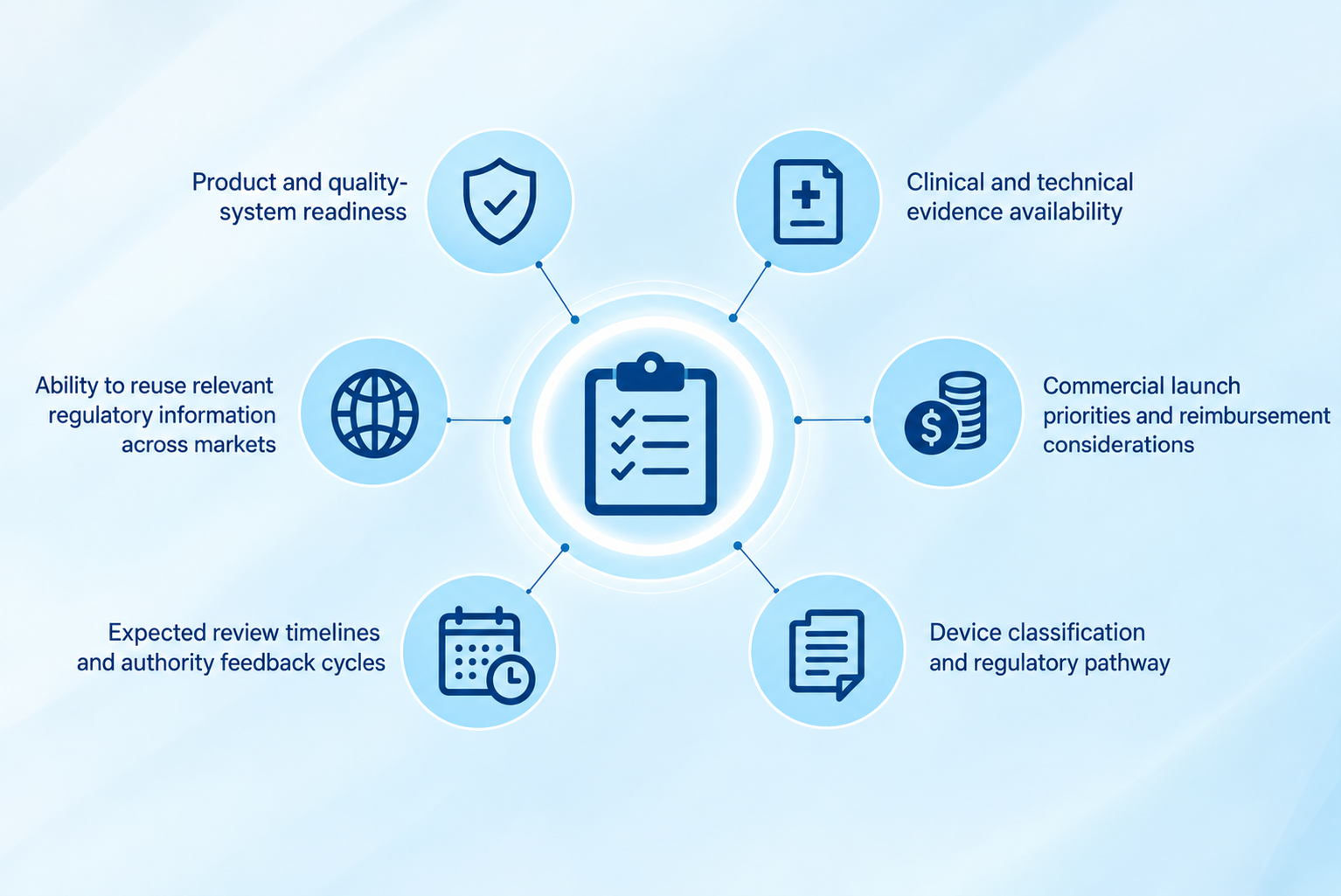
Planning Considerations
-
Product and quality-system readiness
-
Clinical and technical evidence availability
-
Commercial launch priorities and reimbursement considerations
-
Device classification and regulatory pathway
-
Expected review timelines and authority feedback cycles
-
Ability to reuse relevant regulatory information across markets
Post-Market Surveillance & Lifecycle Planning
Post-market surveillance is a core part of medical device regulatory strategy because regulatory obligations continue after market approval. PMS activities support ongoing evaluation of device safety and performance and can inform future submissions, labeling, risk management, and lifecycle decisions.
A proactive strategy should define how post-market information is collected, assessed, reported, and incorporated into future regulatory planning.
- Market Entry
- Approval
- PMS
- Changes
- Renewals
PMS Activities Include
-
- Complaint and adverse-event monitoring
- Vigilance reporting
- CAPA-related inputs
- Updates to technical and regulatory documentation
- Using PMS findings to inform future submissions and lifecycle changes
RIM, PLM & Regulatory Technology
Technology can support regulatory strategy by connecting regulatory information, submission planning, product data, workflows, and reporting. The value comes from having the right information available to the right teams at the point of decision.
A RIM system provides the regulatory layer for managing regulatory information, submissions, registrations, assessments, and related activities. PLM manages product lifecycle information, while QMS/eQMS supports quality processes such as CAPA, complaints, audits, training, and change control. These systems can be complementary when their boundaries and integrations are clearly defined.
RIM
Supports centralized regulatory data, submission and approval tracking, regulatory intelligence, and regulatory workflows.
PLM
Manages product structures, requirements, design information, and product lifecycle changes that can trigger regulatory assessment.
QMS/eQMS
Manages quality processes such as CAPA, complaints, audits, training, and change control.
Regulatory Intelligence
Regulatory intelligence supports strategic planning by helping organizations monitor evolving requirements across markets. When regulatory intelligence is connected to regulatory workflows and product or market data, teams can use changes as inputs to planning and assessment rather than managing updates as a separate information stream.
How RegDesk Supports Regulatory Strategy
RegDesk is a device-native RIM platform for medical device and IVD regulatory teams. It combines regulatory intelligence, submission and approval tracking, change assessment, and regulatory workflows in one environment.
RegDesk supports regulatory teams managing products and regulatory activities across more than 120 markets. Human regulatory experts maintain the regulatory intelligence, while the platform connects that intelligence with workflows and regulatory data to support planning, assessment, and execution.
Global Regulatory Strategy
Medical device regulatory requirements differ across markets in classification, submission pathways, evidence expectations, review processes, and post-market obligations. A global regulatory strategy accounts for these differences early and coordinates market-specific requirements with a common product and evidence strategy.
Region-Specific Requirements
Submission content, formats, and regulatory pathways vary by market and device classification.
Evidence Expectations
Clinical and technical evidence requirements differ across regulatory frameworks.
Approval Timelines
Review timelines and authority feedback cycles differ significantly across markets.
Changing Requirements
Regulatory frameworks evolve; strategy needs a mechanism for monitoring and reassessing.
Cross-Functional Coordination
Regulatory, quality, commercial, and product teams need shared visibility into priorities and dependencies.
Information Management
Maintaining consistent regulatory information across markets requires structured processes and clear ownership.
Common Challenges & Pitfalls
Understanding where regulatory strategies most often fall short helps teams build more resilient planning from the start.
Poor Market Selection
Selecting markets without considering regulatory feasibility, evidence requirements, timelines, and commercial objectives can create avoidable rework.
Misaligned Submission Sequencing
Submitting before product, evidence, or quality readiness can create delays and weaken the intended global sequence.
Changing Requirements
Regulatory requirements evolve, so strategy needs a mechanism for monitoring changes and reassessing affected plans.
Cross-Functional Misalignment
Regulatory, quality, commercial, and product teams need shared visibility into priorities, timelines, and dependencies.
Insufficient Post-Market Planning
PMS, vigilance, and lifecycle obligations should be considered before approval rather than treated as a separate downstream activity.
Fragmented Regulatory Information
Scattered regulatory data makes it harder to understand status, ownership, dependencies, and changes across markets.
From Regulatory Planning to
Regulatory Execution
A medical device regulatory strategy is most valuable when it connects market selection, submission planning, post-market obligations, and regulatory intelligence into a coordinated process.
For regulatory leaders, the objective is not simply to secure approval in one market. It is to build a reliable regulatory operating model that scales with the product portfolio, supports global expansion, and gives leadership clear visibility into status, ownership, and risk. RegDesk connects regulatory intelligence, submission tracking, change assessment, and regulatory workflows in a platform built for medical device and IVD teams.
Building a Strong Medical Device
Regulatory Strategy
A practical medical device regulatory strategy should connect six decisions:
Frequently Asked Questions
What is a medical device regulatory strategy?
A medical device regulatory strategy is a structured plan for how a product will achieve market approval and maintain regulatory compliance throughout its lifecycle. It includes market selection, submission pathways, sequencing, post-market planning, and ongoing regulatory assessment.
How do you choose which markets to enter first?
Market prioritization should consider regulatory feasibility, device classification, evidence requirements, approval timelines, commercial opportunity, reimbursement potential, and available resources. The appropriate sequence depends on the product and business strategy.
How should medical device submissions be sequenced across regions?
Submission sequencing should align product readiness, regulatory pathways, evidence availability, review timelines, and strategic market priorities. A phased approach can reduce duplication and support coordinated global expansion.
What is the role of post-market surveillance in regulatory strategy?
Post-market surveillance supports continued monitoring of device safety, performance, and regulatory compliance after approval. PMS findings can inform future submissions, labeling, risk management, and lifecycle decisions.
How can RIM and PLM systems support medical device regulatory strategy?
RIM and PLM systems serve different but complementary roles. RIM manages regulatory information, submissions, registrations, and regulatory workflows, while PLM manages product lifecycle information and changes that may require regulatory assessment.
How often should a medical device regulatory strategy be reassessed?
A strategy should be reassessed when material changes occur in the product, target markets, regulatory requirements, evidence, business priorities, or post-market information.

